
Do conservative beliefs constitute a personality disorder?
A recent article in Psychology Today says so.

Thanks for reading my free newsletter separating reality from bullshit in pop culture. If you enjoy it, please share it, and please consider becoming a paid subscriber — paying subscribers are what makes it possible for me to write this — and you’ll also receive an additional Thursday edition!

A recent article in Psychology Today called “Do Conspiracy Beliefs Constitute a New Personality Disorder?” makes the argument that two strong predictors of conspiracy belief are (1) paranormal beliefs, and (2) “conservative and Republican-leaning predilections”.
I am not so sure. There is also plenty of data finding conspiracy ideation spread equally across the political spectrum, but we’ll get back to that in a moment.
There’s an elephant in the room here. Since Trump was elected it’s tempting to embrace claims that people who voted for him must be crazy, and that’s pretty much the sentiment this article strokes. However, as scientific skeptics, we recognize that as quite an extraordinary claim, well deserving of our skepticism.
Here’s how the paper gets from conservative to personality disorder. I don’t think they make a strong argument at all, but here it is:
Three categories of personality traits have been associated with conspiracy ideation:
Personality disorders as found in the DSM-5-TR (weak association)
Paranormal beliefs (strong association)
Political ideology (weak association for the left and strong association for the right)
Extreme conspiracy theorists tend to cause distress to themselves, family members, coworkers, etc.
The inability to maintain healthy relationships of those kind is where we cross the line into what we term a mental disorder.
Therefore, conservatives may have a personality disorder.
I have been studying conspiracy theories and conspiracy theorists for a long time, and I’ve also been reading research about the subject for a long time. And never once have I encountered well-performed research showing that conservatives — extreme or not — are more conspiratorial than liberals. In my experience, this paper falls apart on one of its earliest foundations.
In fact, here is a chart showing acceptance of various conspiracy theories by partisan affiliation, in a study intending to answer this exact question (Enders, A., Farhart, C., Miller, J. et al. “Are Republicans and Conservatives More Likely to Believe Conspiracy Theories?” Polit Behav (2022). https://doi.org/10.1007/s11109-022-09812-3):
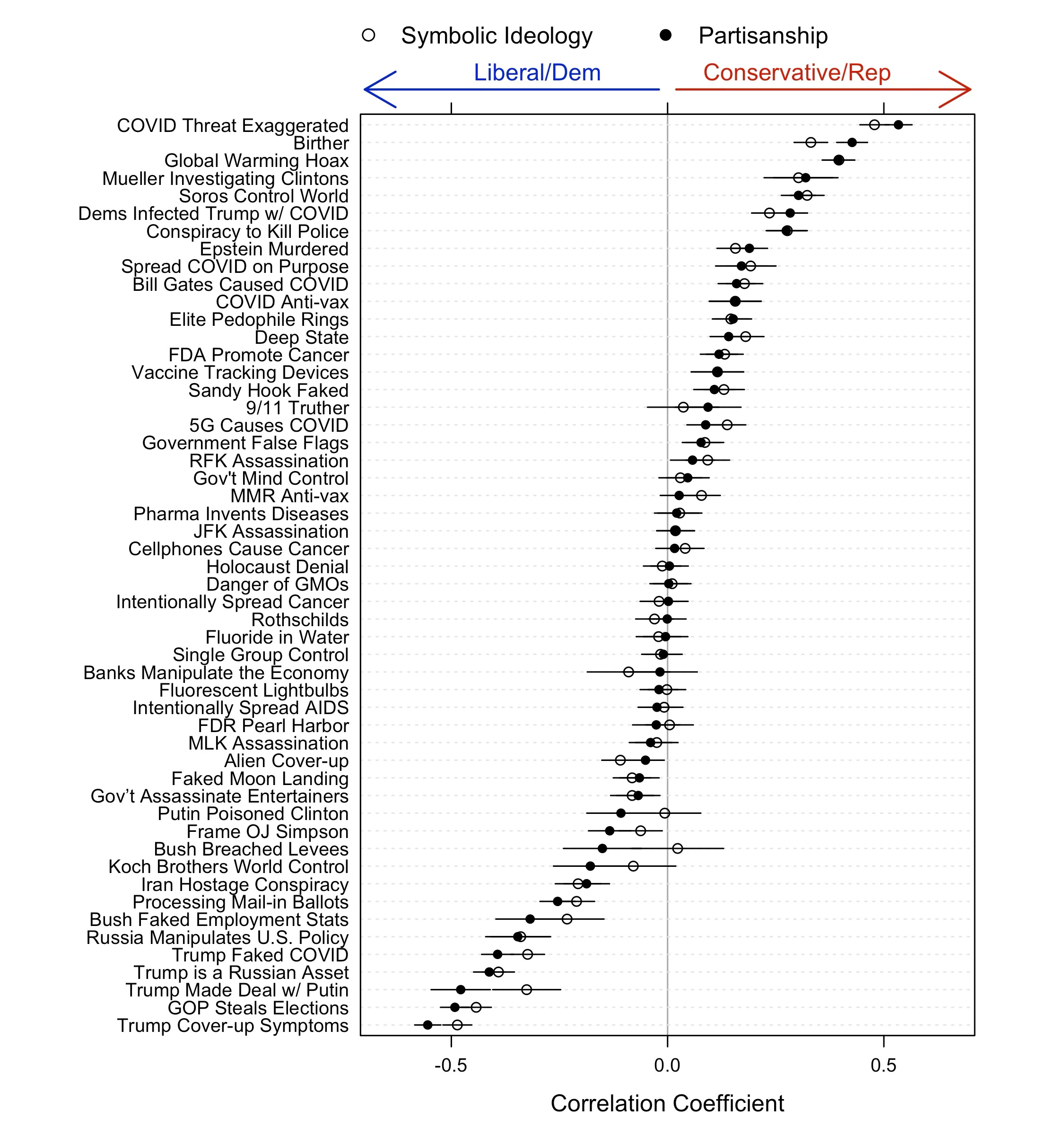
No! No, conservatives are not more likely to be conspiracy theorists, any more than liberals. The difference is in which conspiracy theories they believe. Here’s a conservative conspiracy theory:
George Soros funds all the evil things in the world.
Backspace over George Soros, type in a new name, and you’ve just converted a conservative conspiracy theory into a liberal one:
The Koch Brothers fund all the evil things in the world.
We can go the other direction too. Here’s a liberal conspiracy theory:
The 1% are the reason your life is terrible.
Backspace and retype to convert to conservative:
Immigrants are the reason your life is terrible.
In one of the talks that I give, How to Beat Misinformation, one of the red flags of potential misinformation that I advise people to look out for is:
Does it cast some group as the villain?
This article, starting with its headline, absolutely casts some group as the villain, so I knew to be skeptical going in. I also had the advantage of already having done a lot of work to learn this subject area.
If you follow this blog you know I’ve been deeply critical of some conservative leaders (like RFK Jr. and Elon Musk and just last week the nominee for Secretary of Defense) and especially the so-called Intellectual Dark Web, so I am no supporter of the winners in the recent election. But I also don’t want to see science misused in an effort to misrepresent that reality to further divide us.
The problem with the article is the chart that uses Democrat/Liberal and Republican/Conservative as headings. There are many Democrats with conservative views on some issues and Republicans with liberal attitudes on certain issues. Removing the Democrat and Republican tags would be useful.
Also, some of those conspiracy theories cross political and ideological lines. I found belivers in 9/11 Truth, fake moon landing, JFK assassinations, single group controls world, Big Pharma making people sick deliberately to make money and Covid-19 conspiracies evenly distributed within both the far Left and far Right. At least, that's what I've found here in New Zealand.
I've met people from right across the political spectrum and very few of them are anything but generally rational, articulate and ordinary people getting on with their lives.
That's interesting, but I don't think that study gives the full picture. I realize that people on the left are not immune from conspiratorial thinking (whatever "left" even means: that's very context-dependent). But I do think that conspiracy theories are far more prominent on the right For example, I have spent a fair amount of time in left spaces (ranging from normie liberals to hardcore left anarchists), and yet I had not even heard of maybe half of the left-coded conspiracies that the study mentions.
I think that if you hang out in right-wing spaces, you are far more likely to hear people bring up conspiracy theories, unprompted, and the theories themselves tend to be more extreme. For example, I've talked to normie liberals who believed that grocery stores were raising prices because they wanted Trump to win the election. That's pretty ridiculous, but I've heard a lot of people I know who consider themselves to be normal Republicans repeating completely insane, QAnon-adjacent conspiracies.
A follow-up study might ask people of various ideological persuasions to explain how they think society works, and then code the answers for conspiratorial thinking.